The Collaborative Coaching team offers Professional Development workshops for educators focused on empowering literacy instruction and the practices that allow for this instruction to succeed. We work with schools, districts, and organizations across Massachusetts and beyond. We have partnered with 826 Boston, Boston Public Schools, Everett High School, and more!
In every WordPowered professional development, participants:
- Take part in active, hands-on learning;
- Reflect on experiences, identities, ideas, and implications for the classroom;
- Engage in dialogue with other educators;
- Plan for implementation of new practices and ideas.
Professional Development Offerings
Empowering Writing Instruction (2 hours – 3 days)
Participants in our writing Professional Development offerings develop the knowledge and skill to bring empowering, student-centered writing instruction into their classrooms. Based on our Empowering Writing Instruction Framework, topics include:
- Cultivating a Writing Environment: Foundational Practices
- Writing as Thinking: Using Low-Stakes Writing to Process and Develop Ideas
- Designing Empowering Assignments: Authenticity, Voice, & Choice
- Writers Make Choices: Fostering Agency through Writing
- Writing as a Process
- Models and Mentor Texts
- Peer Collaboration in the Writing Classroom
- Feedback that Works
- Assessing What Matters
Empowering Writing in the Content Areas (2 hours – 2 days)
Writing matters in every discipline, yet it differs across disciplines. We work with teachers across content areas to identify writing opportunities in their existing curricula, and then develop purposeful tasks that deepen student learning. Participants walk away with strategies, assignments, and rubrics they can use right away to create a culture of writing in their classrooms.
Reading Strategies that Support ALL Learners (2 hours – 2 days)
Reading complex texts is critical to students’ success with grade-level material, as well as their own reading and identity development, but it’s a challenge, especially in multilingual settings. Our reading strategies workshops offer classroom-ready strategies that teachers can implement to help all learners—regardless of reading level or language background—comprehend and analyze complex text.
Bridging Reading and Writing (2 hours)
Reading and writing are inherently connected; we become better writers by reading and better readers by writing. In this workshop, we focus on annotation and note-taking strategies that help students deepen their comprehension of text, build knowledge, and learn about the craft of writing.
Writing in the Age of AI (2 hours – 2 days)
Does AI have a place in the writing classroom? We invite educators to think deeply about the role of generative AI in student writing as they work with colleagues to evaluate classroom scenarios, develop guidelines around AI use in their own classrooms, and explore how they can empower students to develop critical AI literacy.
Project-Based Learning (3 hours - 2 days)
Project-Based Learning (PBL) is an empowering instructional approach wherein students learn through projects that address meaningful, real-world topics. Our Teens in Print youth journalism program exemplifies this approach: teens develop literacy, critical thinking, and collaboration skills as they research, write, publish, and produce articles and podcasts about issues that matter to them and their communities. In this workshop, we unpack and explore the PBL model as illustrated by Teens in Print, and we guide participants to develop their own classroom-ready projects.
Fundamentals of Lesson Design (3 hours – 1 day)
The lesson plan is an essential building block of good teaching. This workshop introduces two fundamental yet powerful frameworks for lesson planning: backwards design and Universal Design for Learning. Participants at all levels of experience can apply these frameworks to plan effective, accessible, and meaningful lessons for their own contexts.
Grading for Equity (4-8 sessions)
Grades hold tremendous power in schools and beyond. They impact how students see themselves, how others see them, and whether doors open or close for them. Participants in our in-depth book study of Joe Feldman’s Grading for Equity interrogate their beliefs around grading, learn about the principles of equitable grading, and prepare to implement more equitable grading practices at the classroom, department, or school-level.
Language Acquisition: From Theory to Classroom Practice (2 hours)
How can teachers best serve the English learners (ELs) in their classrooms? The answer starts with understanding the second language development process. In this workshop, we unpack language learning and language acquisition and offer concrete classroom strategies that teachers can implement to support their ELs in acquiring language naturally.
Working with Neurodivergent Learners (2 hours – 1 day)
Neurodiversity is the norm in every classroom. Our workshops focus on what educators can do proactively to set up their neurodivergent learners for success, as well as what they can do in the moment, when students become dysregulated. Participants leave prepared to improve the physical classroom environment, design more inclusive lessons, and respond to dysregulated students.
Inside the Middle School Brain (2 hours)
Educators must understand their students in order to be able to teach them with compassion. In this workshop, participants explore principles of adolescent psychology and apply these principles to troubleshoot common challenges in middle school classrooms. Participants walk away better equipped to foster classroom environments where early adolescents can thrive.
How do Teachers Learn? A Workshop for Coaches & Administrators (2 hours – 2 days)
In this interactive workshop for coaches and school-based administrators, we address how teachers learn best and how schools can do a better job of fostering teacher learning. Participants explore research into teacher learning, reflect on their current school context, and collaborate with colleagues in order to improve professional learning for teachers.
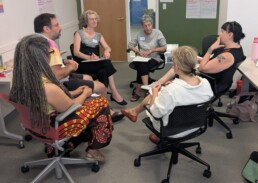
Are you an educator or school leader interested in professional development?
We work with schools, districts, and organizations across Massachusetts and beyond.