
By Abdi Mohamed Ali, Ed.D
I am sitting with the feedback forms from two rounds of workshops our Collaborative Coaching team completed with 100+ teachers at Everett High School. Here’s a sampling: one teacher writes with the enthusiasm of discovery: “Students are taking a more active role in notetaking and being less passive learners.” Another, more measured, responds: “Most of the strategies that we covered last session, I had already been using.” A third offers this paradox: “Strongly disagree” to questions about changing practice, then rates the session a perfect five.
These are not contradictions to be resolved, but rather windows into the complex ecology of a high school faculty: each teacher carries their own history, their own repertoire, their own sense of readiness for what comes next. And somewhere in these disparate voices lies questions that every professional development facilitator must answer: How do you design learning experiences that honor the veteran teacher’s expertise while sparking the beginning teacher’s confidence? How do you create a room where everyone grows to make their classrooms more equitable?
The data reveals a complex topography in teachers’ sense of the workshops: some embrace the strategies with fervor; others indicate they are already walking the walk; still others are hungry for what comes next, ready for more nuanced, more sophisticated conversations.
Our Collaborative Coaching team must hold this range of needs, from reviewing to refining to revitalizing practices, and everything in between.

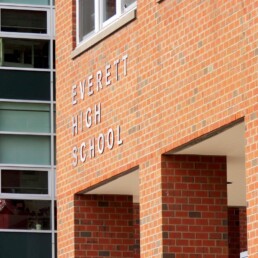
WordPowered (formerly WriteBoston) has, since its inception, understood that principles of equitable education, informed by educators’ knowledge and our belief in their capacity to create change, have to be adapted to school contexts. Using feedback from Everett High School teachers who participated in two days of workshops, which our Collaborative Coaching team facilitated, I attempt to draw out emergent principles on designing professional development to meet diverse educators’ needs.
Architecting Learning for Adults
What becomes visible in the Everett teachers’ reflections is not what WordPowered’s coaches taught, but how they structured the learning, using an architecture that allows for multiple entry points and varied trajectories of growth.
Growth is not always about doing something different. Sometimes it’s about doing what you already do with greater awareness, with clearer understanding of why it matters, with renewed commitment when the daily grind threatens to turn practice into a checklist.
When the teachers walked into the Crimson Cafe at Everett High School on November 4, WordPowered’s Collaborative Coaching team appeared to have spent weeks learning the unique/particular ecology of the school. The spontaneity that is felt–teachers sharing their experiences, breaking into department groups, having time to plan with their specific curriculum–was actually the result of meticulous preparation. Here’s the evidence I gathered from reading their emails to the school:
- They requested curriculum materials from every department
- They asked about specific breakout spaces, inquiring, “the larger department would stay in the Crimson Cafe… would it be possible for us to relocate the smaller group to a nearby space?
- They designed differentiated focal points by department: ELA and ESL would “dig deeper into two-column notes,” while Math and Health would “explore low-stakes writing.”
With information, our coaches build a structure flexible enough to hold 100+ teachers at varied starting points.
Hands-on Learning
Another principle emerges again and again in the feedback, though teachers name it differently: “I always love how we do the hands-on activities that we’re learning about,” writes one. Another: “Facilitators modeled the strategy of introducing low-stakes writing as an activity that we had to try out.” And a third, with a beautiful economy: “I liked going through the process of free writing.”
Is this modeling as pedagogy? Not as in watching a demonstration, but the kind where educators inhabit the experience themselves before their students do? It also occurs to me that the coaches are modeling something else: a research stance. The coaches ask teachers to engage in low-stakes writing, to experiment with the two-column notes, and to feel what it’s like to be a learner encountering these tools. This is empathy.
And empathy grounded in equity produces differentiated outcomes: the novice teacher interacts with tools authentically, whereas the veteran teacher discovers something else–perhaps refinement, perhaps a new question.
The coaches are showing teachers how to build instruction from student experience by centering learners’ experience.
One veteran teacher rates the session a five, but with respect to changes to practice, she notes, “I was already doing it,” and adds, “the writing/thinking, it was perfect.” What she found, it seems, was not a new strategy but something more valuable: a confirmation that her instincts are sound, refinement of techniques she’d been using, and perhaps most importantly, a community of colleagues who are surfacing similar problems and testing practices that work for their students.
Time and Space for Translation
Another principle proves even more crucial to our coaches’ success, mentioned so often it becomes a refrain: collaborative planning time. Teachers praise “the smaller department time,” “time to plan with teams,” “opportunity for discussion and working time with content level and team,” “lots of reflection time and collaborative time.”
This is where differentiation happens organically, not through the coaches’ orchestration but through the conversations teachers have with each other. But again, reading the emails, I see this wasn’t accidental. The coaches had specifically requested breakout spaces. They had asked teachers to bring “lesson plans and/or curriculum materials that you will be teaching in the next few weeks.” They had organized departments strategically, keeping larger groups in the main space, moving smaller groups to “nearby spaces” where conversations could be more intentional.
One teacher captures the power of this structure: “Thank you for giving us so much space to discuss the pieces of this topic that were relevant to our specific contexts!” There are contexts defined by discipline within the school context. The word “space” carries weight here, not empty time; space is generous, intentional room for teachers to do the work of translation, to ask: What does this mean for my ninth graders? For my English language learners? For my AP Chemistry students who resist writing?
Evidence of Growth
When I trace the arc by following the data responses from September and November PD workshops, what emerges is not a uniform story of transformation, but many stories, each representing growth from a different starting point.
The teachers who have taken strategies from the September workshop and woven them into the fabric of their daily instruction: “My students complete some sort of low-stakes writing every day. They also regularly utilize two-column notes in order to collect evidence and analyze the text.” Another teacher reports, “I have been using two-column notes more in my class more in my class so regularly that students feel comfortable and confident using them, I have to use little instruction or explanation and they know my expectations.”
There are teachers whose growth is refining existing ones, not adopting new strategies.
And there are teachers who describe a more subtle growth: a shift in perspective rather than practice.
Practice Round-up
There is this notion in education that good professional development should “meet teachers where they are.” We say it all the time. It’s in grant proposals we write for WordPowered, in every PD evaluation rubric, every conversation about adult learning. But what does it actually mean when “where they are” is in professionally different places?
At Everett High School, the Collaborative Coaching team designed professional development that didn’t require everyone to arrive at the same destination, but rather helped each teacher take their next step.
This is differentiation not as accommodation–a watering down for those who struggle, an enrichment for those who excel–but as recognition of what any good teacher knows: learning is not linear, growth is not uniform, and the same experience can be transformative in entirely different ways for different people.
The coaches’ achievement is that they created conditions where each teacher could find something worth taking back to their classroom by building a structure that could hold complex needs. A space as generative, intentional, structured but not scripted.
Not answers, but the conditions for discovering them. Not a single path. Not generic professional development but something dynamic and responsive to this school, these departments, these teachers participating in these workshops.